
PRISM Work
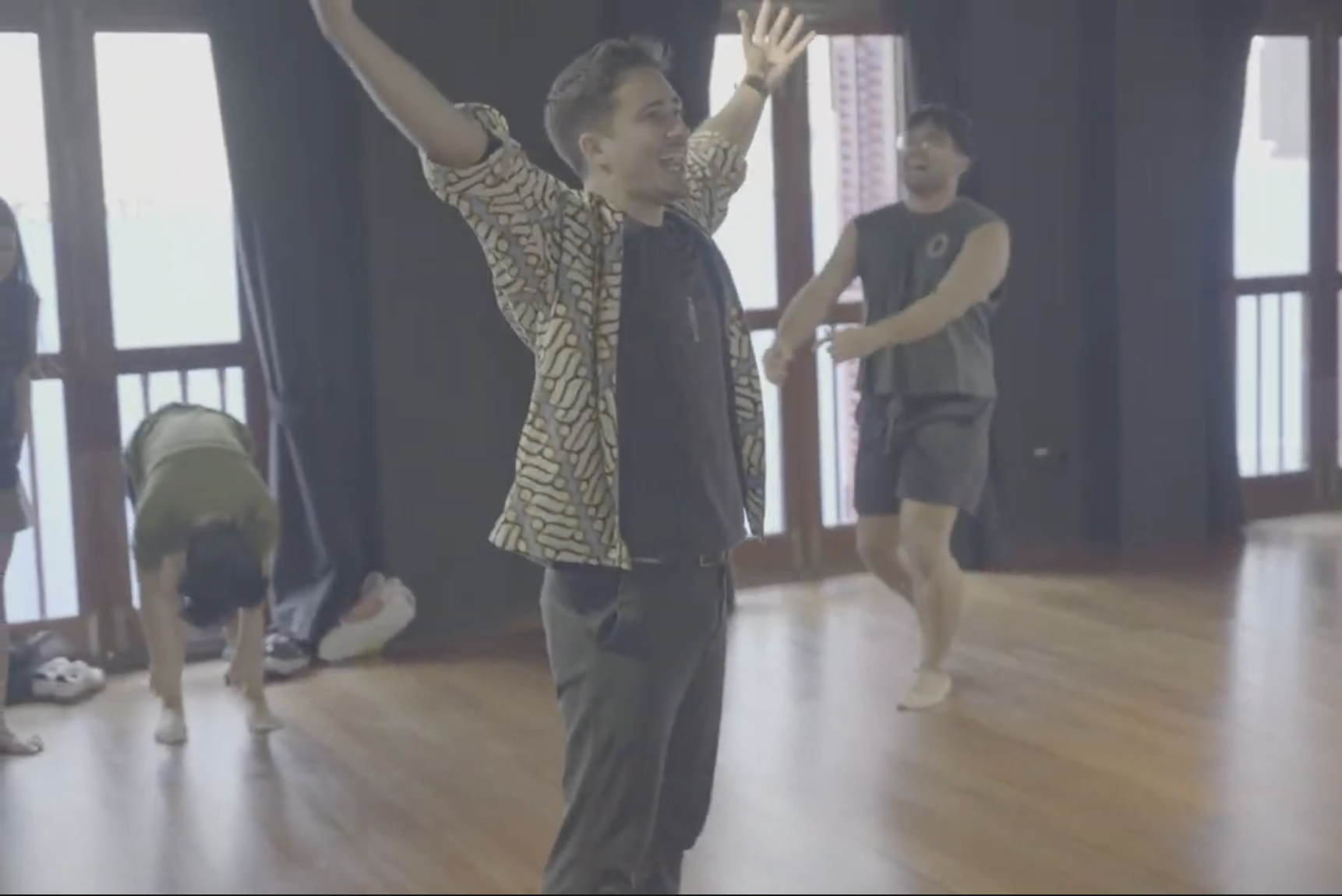
PRISM stands for Polysensorial Rituals, Imagery, Silat & Mask. It is a unique blend of Poleng Mask Work (a combination of psychosomatic movement and archetypal masks), Silat Tua (a traditional martial art from the Nusantara and surrounding areas of Maritime Southeast Asia), and theatre techniques.
The methodology uses evocative prompts and rich imagery to increase awareness of all the body’s subtle sensations, connect to the imagination and provide tools for expanding the capabilities of our creative expression and self-reflection. The improvisational nature of movement, oscillating between the spectrum of form and freedom, invites each participant to develop their own deep personal connection with the work.


The Main Components of PRISM:
The Masks
Silat Tua
(Forms & Drills)
Polysensory
Awareness &
Elemental
Work
Sculpting
Sites
Vocalscapes
Tari
Circle
If you would like to experience this work, reach out to us.
The Masks

We use masks as a training instrument, because they have an uncanny ability to work both on the internal transformation of the wearer’s psyche and imagination, as well as the external transformation of habitual expressions, gestures, postures and movement patterns.
The masks we use are:
carved out of Pule or Pulai wood
not attached to traditional mask practices, although certainly informed by other systems such as Neutral mask, Larval, Grotesque, Clown, Commedia, and Poleng Mask Work
designed by our team with a distinct intent such as a folk character, an archetype, or an abstract image, each with a different emotional and physical centre.
These masks allow one to embody new personas, reach deeper emotional truths, as well as unpack and reflect upon the multitude of one’s Self. They can be layered with numerous other elements and imagery.
Note: Originally developed to train actors, the method has evolved to be accessible to anyone seeking creative liberation and awareness of one’s mind through the body. The central purpose of the work is to begin listening more intently to whatever sensations and impulses that arise within the body. This is also available, in part, under our Performance Practice offering, Poleng Mask Work.


We incorporate basic footwork, stretching kicks, meditations, and most notably animal movements from the traditional martial form, Silat Tua.
Central to Silat Tua’s pedagogy is the idea of mimicking and drawing inspiration directly from nature to glean important lessons around our bodies and its natural movement patterns – unique to each of us.
A key component to our methodology’s incorporation of Silat Tua is the discovery of one’s personal animal. This serves as an image unique to each practitioner’s interpretation and encourages agency and creative ownership in each practitioner’s journey of discovering one’s Self.
Note: Elements of this work are woven into our Performance Practice offering, Martial Arts for Artists.
Silat Tua
(Forms & Drills)


Polysensory Awareness & Elemental Work
We use the term ‘polysensory’ instead of ‘multisensory’, because a polysensory approach incorporates a wider array of stimuli beyond just our typical five sense (hearing, smelling, tasting, touching and seeing). These five senses are what we might call exteroceptive, or sensing stimuli outside the body. There are in fact six systems of sensing which we incorporate:
Exteroceptive
Interoceptive
Proprioceptive
Kinaesthetic
Power, Passion, Willpower, Sensuality
Acceptance, Lightness, Breath, Ease
Associative
(memory)
Imagined
A polysensory approach also acknowledges how all these different systems of sensing overlap and slip into another constantly. We engage and stimulate this process by using guided prompts with rich imagery. Much of our imagery is informed by nature, such as the use of element work.
Air (Water)
Tanah (Earth)


Flow & Fluidity, Touch, Feelings, Sensations
Form, Stability, Structure, Physicality

Api (Fire)

Angin (Wind/Air)

Cahaya (Aether)
Intuition, Spirituality, Atmosphere
Each element connects to distinct emotional and physical attributes, qualities of movement, and different areas of our lives while also providing us with pedagogical themes as we move through our methodology.
Note: This also informs the structure and facilitation of our Guided Experiences in Movement & Meditation (GEMM) offering.
Sculpting Sites
We combine our research on somatic awareness and polysensory attunement practices to a space alongside movement composition principles of time and space. This component provides a shared vocabulary of movement for practitioners to become aware of themselves, to interact intuitively with space, time, each other and to expand their awareness and imagination.
Note: This is also available, in part, under our Performance Practice offering titled Sculpting Sites.
Vocalscapes
We use somatic awareness exercises and improvised choral work to strengthen listening skills and connect voice, breath, body and imagination.
The work is inspired by:
Methods of voice & speech training developed by Phil Thompson and Dudley Knight, in particular their use of experimenting with speech through gibberish (or what they call “Omnish”).
The concept of Freesense (as opposed to nonsense) briefly discussed by ecological philosopher David Abram. It follows the thought that language, speech, and sounds are all part of a wider conversation going on between all things; an exchange between subjects and their environments exchanging multiple meanings. Intention can be conveyed with more than just words.
Tari Circle
Tari means ‘to dance’ in Malay. The circle forms much like a Capoeira Roda or the Hip-Hop Cypher battle scene. Rather than placing a focus on competition, our Tari Circle centres itself on listening and empathetic exchange. We incorporate elements of storytelling, music, dance and role-play.
The circle is a useful frame for working directly on the potential of each individual’s body, developing concentration, imagination, awareness, sense of weight, direction, levels, rhythm and tempo all in relation to fellow practitioners.
By navigating these concepts in the presence of other moving bodies, we deepen our relationship to ourselves. We are each other’s mirrors, and it is in the collective that revelation and transformation can be found.
Connect with us if you’re curious about our practice and research, would like to exchange knowledges, or experience the transformative work of our methodology.